The HaLF-DOME study was a prospective, multicenter, controlled, double-masked, randomised study to evaluate the efficacy and safety of Lacrifill® in treating chronic DED compared to Oasis Form Fit canalicular plugs.1
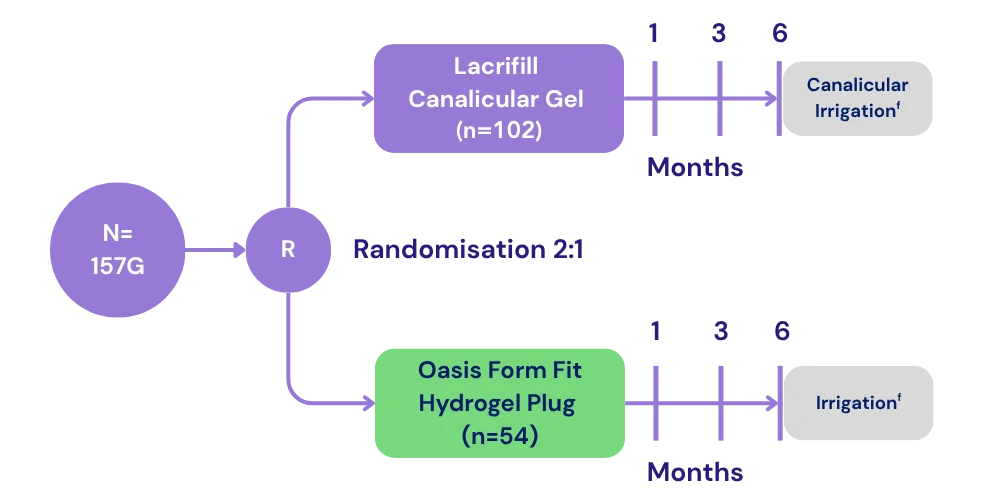
Primary endpoint

Non-inferiority of the mean change from baseline to month 3 in the Schirmer score (non-inferiority margin of 2.5 mm).1

Secondary endpoint

Non-inferiority of the proportion of patients achieving improvement from baseline to month 3 in OSDI score by a minimal clinically important difference.1

N 157G 1 | Lacrifill
| Lacrifill

Improvement in tear quantity sustained for 6 months1

Lacrifill® met its primary endpoint of non-inferiority compared to Oasis Form Fit as measured by Schirmer test score at 3 months.

Lacrifill® demonstrated statistically significant improvement in Schirmer test score from baseline to Month 3 and Month 6.¹

Lacrifill is a treatment that is proven to deliver sustained improvements for your patients over 6 months.1

Improvement in dry eye symptoms sustained for 6 months1

Lacrifill® demonstrated significant improvement of symptoms of DED from baseline to month 3 and month 6.1

Lacrifill is a treatment your patients your patients can rely on for symptom relief at month 6.

| Lacrifill
image 13 | Lacrifill

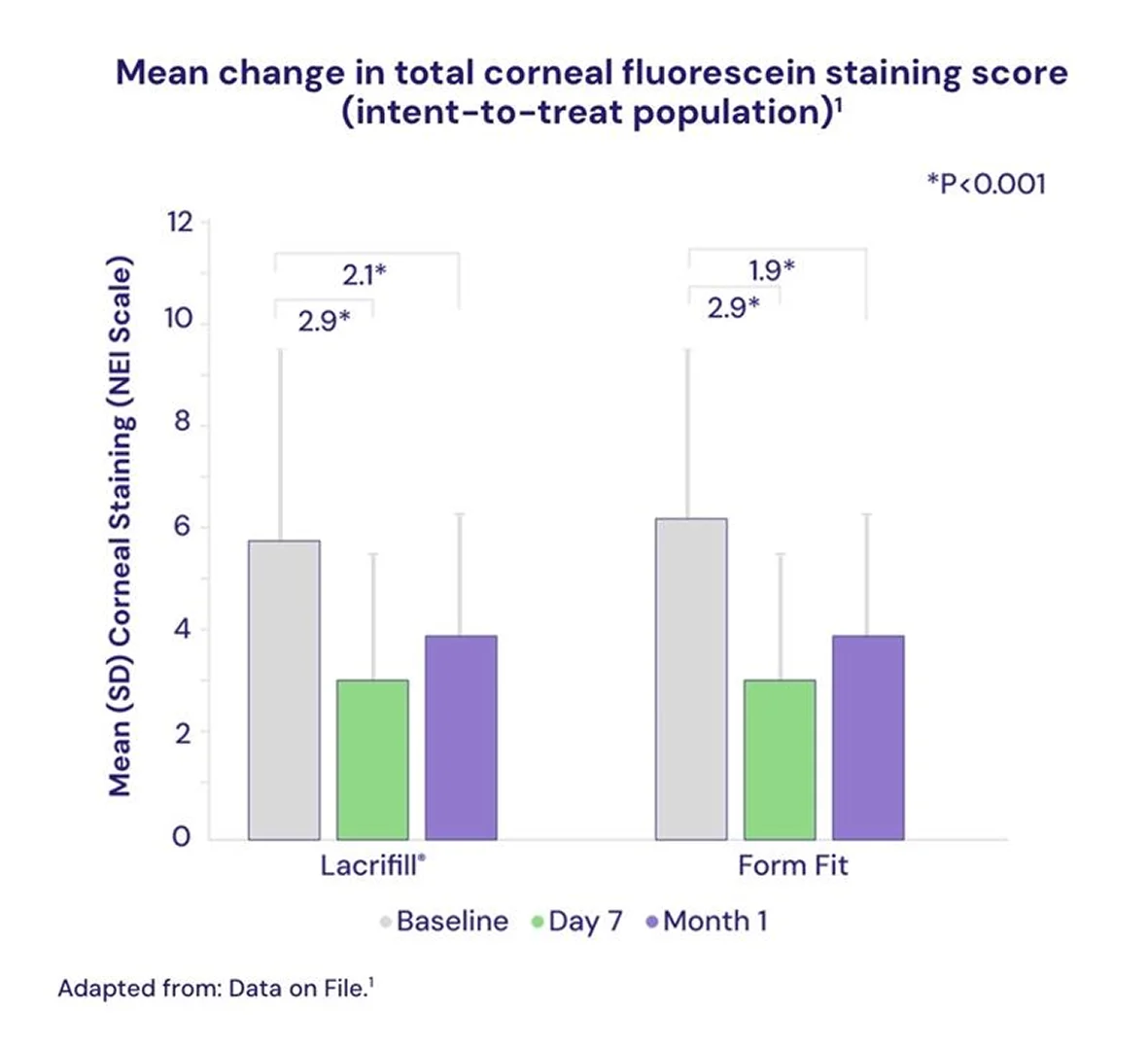
Achieve ocular surface control within 7 days with Lacrifill

Lacrifill resulted in significant improvement in corneal straining from baseline to Day 7.2

Lacrifill is a treatment that can give you rapid control over your patients ocular surface, giving you the best chance of quality surgical outcomes and highly satisfied patients.
There was comparable incidence of ocular device-related AEs between treatment groups

Summary of adverse events (safety population)¹

Scroll to the right to see all data.

Parameter Lacrifill®
(n=103) n (%)
Form Fit
(n=54) n (%)
Total
(N=157) n (%)
Number of patients with ≥1 ocular device-related AE 26 (25.2) 14 (25.9) 40 (25.5)
Most common ocular device-related AEs
Eyelid pain 5 (4.9) 1 (1.9) 6 (3.8)
Epiphora 8 (7.8) 3 (5.6) 11 (7.0)
Blepharitis 2 (1.9) 1 (1.9) 3 (1.9)
Procedural pain 7 (6.8) 3 (5.6) 10 (6.4)

N=total number of patients in the respective treatment group. Percentages were based on the total number of patients in each treatment group. AEs were coded using Medical Dictionary for Regulatory Activities (MedDRA) 23.1. Patients experiencing >1 AE were counted once within that preferred term. Device-related AEs were those categorised as definite, probable, and possible.

Adapted from: Packer M, et al. 2024.¹

Lacrifill® offers clinicians a treatment that acts quickly, delivers measurable and sustained outcomes, with a comparable safety profile to an established treatment, all backed by robust clinical evidence in the HaLF-DOME study.

Latest Lacrifill® Resources

  • onlineweb | Lacrifill

    Videos

    On Demand Webinar – What your patients expect and what their ocular surface demands

  • lacrifill package 2 | Lacrifill

    Product materials

    Receive more information

  • thumb | Lacrifill

    Product materials, Videos

    Administration Training